Membre AA qui a fondé "Pharmacomanes Anonymes"

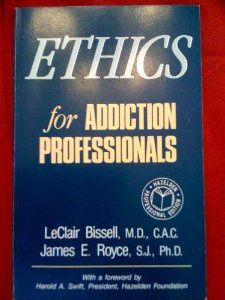
LeClair Bissell, died 20.08.2008,
member of INTERNATIONAL PHARMACISTS ANONYMOUS
Bissell is also the author of "The Cat Who Drank Too Much", a children's book.

She served as president of the American Society of Addiction Medicine and was on the Carter Mental Health Commission's Task Force on Alcoholism.
"There's another part of it, too," LeClair continued. "After setting up the training center, I was increasingly frustrated by doctors and educators who thought all alcoholics were "derelict men under a bridge."
There was an urgent need to acquaint them with professionals who were alcoholics.
We used AA members who were also professionals to make the point. It became much less scary when they related their terrible experiences and could now say they’d been dry for a year.
"You tend not to turn in a colleague if you know your action is going to end her career," she added. "You’re much more likely to get help for her if you can see a good prognosis in the future."
She was a real expert and a pioneer in the treatment of alcoholics and substance abusers. She humanized their treatment. In fact, when I started to work part-time for SWAFAS [Southwest Florida Addiction Services] not so long ago, I soon realized I didn't know anything about the treatment of addiction - LeClair mentored me, guided me, pointed me in the right direction. I really appreciate her kindness in sharing with me what she knew of her specialty."
She was still a staunch AA member, even after years of being dry.

Le rétablissement devrait se focaliser sur le traitement, pas sur la punition



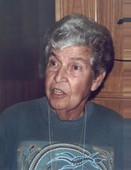

Une de ses interviews link
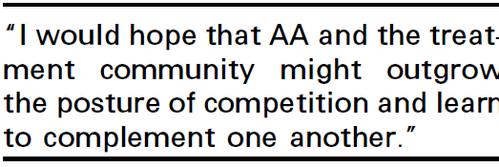
J'espère que AA et la communauté thérapeutique vont surmonter leur posture de compétition et apprendre à se complèter l'un l'autre
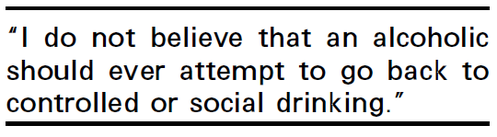
Je ne crois pas qu'un alcoolique devrait un jour essayer de retourner à une consommation contrôlée ou sociale

Et avant la loi du sénateur Hughes, en 1970, les hôpitaux pouvaient -et en fait le faisaient- rejeter l'alcoolique et les patients souffrant d'addiction, juste à cause du diagnostic

L'attitude vis-à-vis des patients qui étaient alcooliques était, à la base, que leur alcoolisme n'était pas quelque chose qui concernait les médecins

Dès que les gens avaient été traités intrinsèquement pour alcoolisme, et cela se vérifiait en première ligne, alors une variété de traitements apparaissait fonctionner
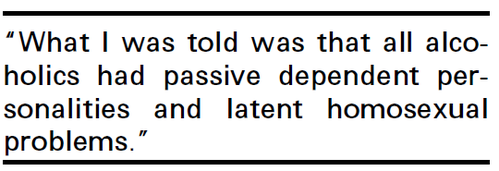
On m'avait dit que tous les alcooliques avaient une personnalité passive dépendante et des problèmes homosexuels latents